

Sophie Barbe
By now, most people have heard about the endless waiting lists for an ADHD diagnosis. Still, the struggle doesn’t end there, with many unable to access medication or support even after their diagnosis.
Getting An ADHD Diagnosis
Last July, a BBC investigation found many areas of the UK had backlogs for ADHD assessments that would take at least eight years to clear.
The NHS also warns patients requesting an ADHD assessment that current waiting times are “in excess of 7 years.”
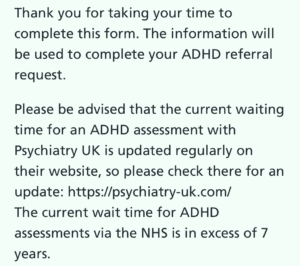
Screenshot of a response from the NHS. Image courtesy of Sophie Barbe.
These figures are extremely disheartening for many who cannot receive the support they need while waiting for a diagnosis. In a world which is already less accommodating for neurodiverse people, a minimum of seven to eight years seems an impossible time to go without any support. Many people cannot wait this long, with their mental health and general well-being on the line. However, there aren’t many other options, as private diagnoses are simply not viable for many.
“The struggle to get a diagnosis was only the first hurdle”
To try and cut waiting times, the NHS offers a Right to Choose option, allowing patients to receive a diagnosis via an alternative, private provider. The Right to Choose waitlist is much shorter than the NHS one, however, these providers are also experiencing a significant increase in demand for their services. Estimated waiting times vary from eight weeks to 18 months, which is still far too long.
My Experience
For me, the struggle to get a diagnosis was only the first hurdle. I was fortunate enough to be able to pay for a diagnosis privately, and was diagnosed with ADHD in 2023. However, receiving medication privately proved too expensive. Not only did I have to pay for my medication, but also for every session reviewing my dosages. This was not feasible for me, so I decided to try for medication via the NHS.
In true ADHD style, I procrastinated contacting the NHS for a whole year. I was scared by the few medications I had tried privately. They did little to help my ADHD and led to side effects such as increased anxiety and reduced appetite.
When I finally decided my symptoms were getting too hard to manage without help, I contacted my GP for advice on my next steps. I had, misguidedly, thought the process would be simple, as I’d already been diagnosed. I was hoping I could skip the long waiting lists and just be prescribed medication.
My Setbacks
I soon found out this was not the case. After I finally arranged an appointment with the GP – a task I find extremely hard to complete due to my ADHD – I was told that waiting lists for medication were too long via the NHS, so I should try the Right to Choose path.
“The whole process is also extremely inaccessible for those with ADHD”
The GP sent me a list of providers and their information so I could decide which provider to receive medication from. This process already proved unaccommodating for people with ADHD, as it involved lots of follow-ups and few reminders or help from the GP. After much back and forth, I finally confirmed with my GP the provider whom they referred me to.
I waited a month without hearing anything before I decided to chase up my referral. It turns out, the external provider required me to complete another ADHD assessment, which would take between six to eight months, before they could begin the process of giving me medication. This could then take up to an additional six months. Of course, the external provider only told me this once I’d contacted them, and the GP had not informed me this would be the case.
The Battle For Medication And Support
Unfortunately, I’m still trying to find an option which doesn’t involve waiting months to redo my whole assessment or paying a ridiculous amount of money.
“Even after the long process of a diagnosis, people still aren’t able to get the support they need”
The whole process has been frustrating and demoralising, and I feel misled into believing it is easier to get support post-diagnosis. I recognise that I am lucky to have one, as there are many still waiting for theirs. But it feels inconceivable that even after the long process to get diagnosed, people still can’t receive the support they need. The whole process is also extremely inaccessible for those with ADHD, and it would be tempting to just give up.
Therapy is another way to support those with ADHD in managing their symptoms. However, in my experience, NHS therapy services are often ill-equipped to help. Many therapists do not know or understand enough about the condition to provide adequate support, which is paramount when working with someone who has ADHD or any neurodiverse condition.
Understanding how our brains work differently is key to giving the right support to neurodiverse patients. Unfortunately, I have had too many experiences with therapists who have not considered how much my ADHD affects my anxiety and other conditions.
A lack of government funding and the “broken NHS” system are the obvious factors to blame for the dire situation. But these issues cannot be fixed overnight. In the meantime, the NHS should focus on reforming the system to make it more accessible. It is important to provide better support as patients navigate the difficult diagnosis and treatment process.
The system right now is simply unacceptable. The well-being, and potentially the lives, of many are at risk until something changes.
READ NEXT:
-
THE DANGER OF LINKING ADHD TO EATING HABITS
-
NEURODIVERGENCE IS NOT A NEW TREND
-
WOMEN WITH ADHD: A HIDDEN JOURNEY
Featured image courtesy of Christina Victoria Craft via Unsplash. No changes have been made to this image. Image license found here.
